Hyderabad's water shortage traces to leaky pipes, not just a weak monsoon
With reservoirs at about 25 per cent and tanker bookings tripling, an opinion piece argues that 35 per cent non-revenue water loss, not El Niño alone, drives the city's recurring scarcity.
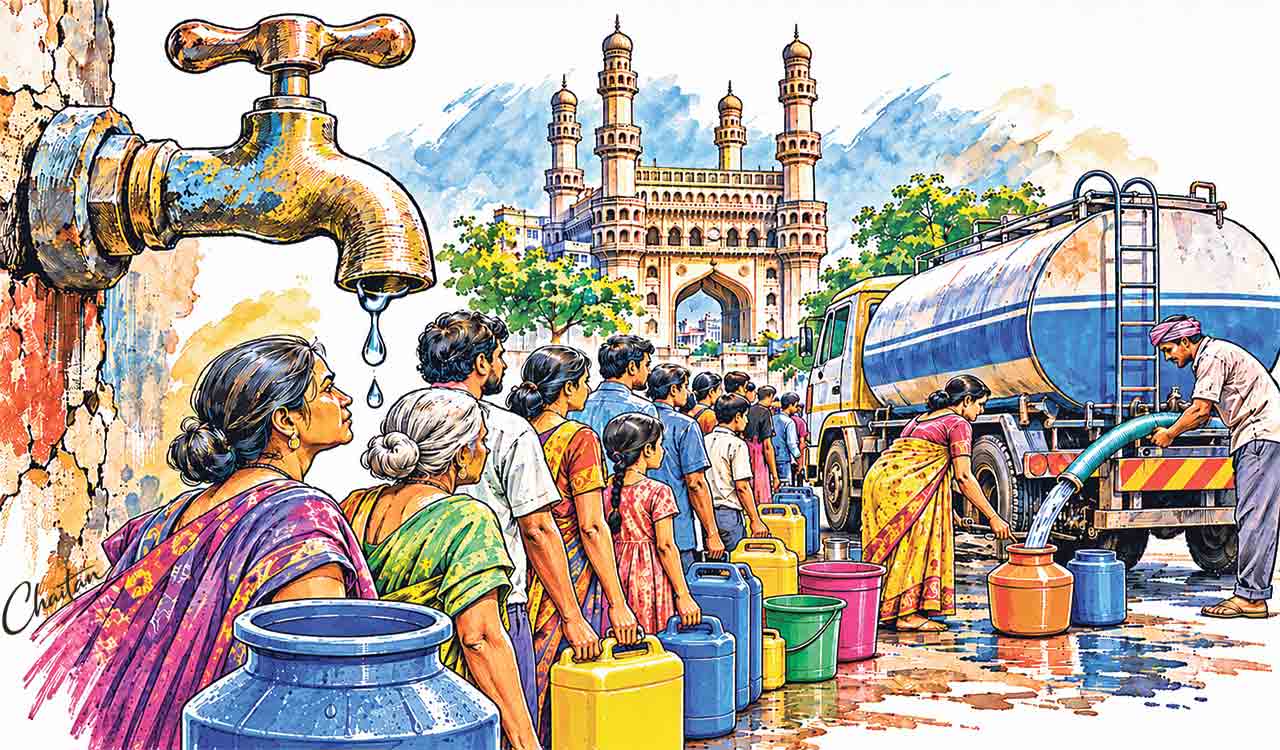
Hyderabad's water stress this year reflects a failure of distribution as much as a failure of rain, according to an opinion article by Devana Varshith published by Telangana Today. The piece says roughly 35 per cent of the water the city supplies never earns revenue, lost to leaks, theft and other gaps.
The immediate numbers are stark. Reservoirs feeding the city stand at about 25 per cent of capacity, against 65 per cent in October last year. Tanker bookings reached around 1.48 lakh in September, up from 47,000 a year earlier. Telangana recorded a 17 per cent rainfall deficit, and storage in the Krishna basin is 72 per cent lower, with the Godavari basin 40 per cent lower, year on year. El Niño is the obvious culprit.
The author contends that weather cannot explain a pattern that repeats. Kukatpally, Miyapur, Manikonda, Gachibowli and Madhapur face shortages almost every year, including in better monsoons. Meanwhile, the Hyderabad Metropolitan Water Supply and Sewerage Board supplies more than 2,600 million litres a day, about 200 litres per capita daily. That sits above the Union government's urban benchmark of 135 litres and the figures the article cites for London, Amsterdam and Tokyo.
The gap between supply and experience is what the article calls non-revenue water: ageing pipelines, patchy metering and slow repairs. It estimates that cutting losses from 35 per cent to 15 per cent would save about 520 million litres a day, enough for nearly 39 lakh people. That is a supply gain achieved without a new reservoir or river transfer.
The article points to cities that have done it. Puri in Odisha cut losses from 47 to 15 per cent, Dhaka from 40 to 5 per cent, Manila from 63 to 13 per cent and Jamshedpur from 36 to 10 per cent. The author argues these results show that middle-income cities can achieve sharp reductions through management alone.
Puri's route began under Odisha's Sujal "Drink from Tap" Mission, launched in 2019 to deliver 24x7 supply. Officials first audited how much water entered the network and where it vanished, then mapped the system to find old and defective pipes. Sensors placed at intervals monitored pressure and flow, letting engineers spot hidden underground leaks by comparing readings between points, followed by repairs or replacement.
The second step was near-universal metering, along with standardised new connections. Previously, consumers hired local plumbers to tap the main, often damaging distribution lines. The excerpt available breaks off there, but the argument is clear: for Hyderabad, plugging the leaks is the faster, cheaper route to water security than waiting on rain.
Read the original opinion piece at Telangana Today.